
You send a rent increase notice to your tenant, and a week later you hear that the increase was too high. It wasn't because the market changed. It was because your property falls under a different set of rules than you thought. This happens to Los Angeles owners every year, and it can be costly.
Los Angeles has two main rent rules that most owners deal with: the city's Rent Stabilization Ordinance (RSO) and California's statewide Tenant Protection Act, better known as AB 1482. They limit rent increases in very different ways, and only one of them usually applies to your unit. On top of that, a few cities in our area, like Santa Monica, Beverly Hills, Culver City, and Pasadena, have their own local rules.
In this guide, we'll walk you through how each law works, how to figure out which one covers your rental, and the common mistakes we see owners make. By the end, you'll know how much you can raise rent and what steps keep you on the right side of the law.
Key Takeaways
- The LA RSO generally covers rental units in buildings built on or before October 1, 1978, inside the City of Los Angeles.
- RSO units can be raised 3% per year from July 1, 2025, through June 30, 2027, according to the Los Angeles Housing Department (LAHD).
- AB 1482 covers most other rentals that are at least 15 years old. In the Los Angeles area, the cap is 8.7% from August 1, 2026, through July 31, 2027.
- Many single-family homes and condos are exempt from AB 1482, but only if the owner isn't a corporation or REIT and the tenant received the required written notice.
- Both laws come with just cause eviction rules, so rent limits are only part of the picture.
What Is the Los Angeles Rent Stabilization Ordinance (RSO)?
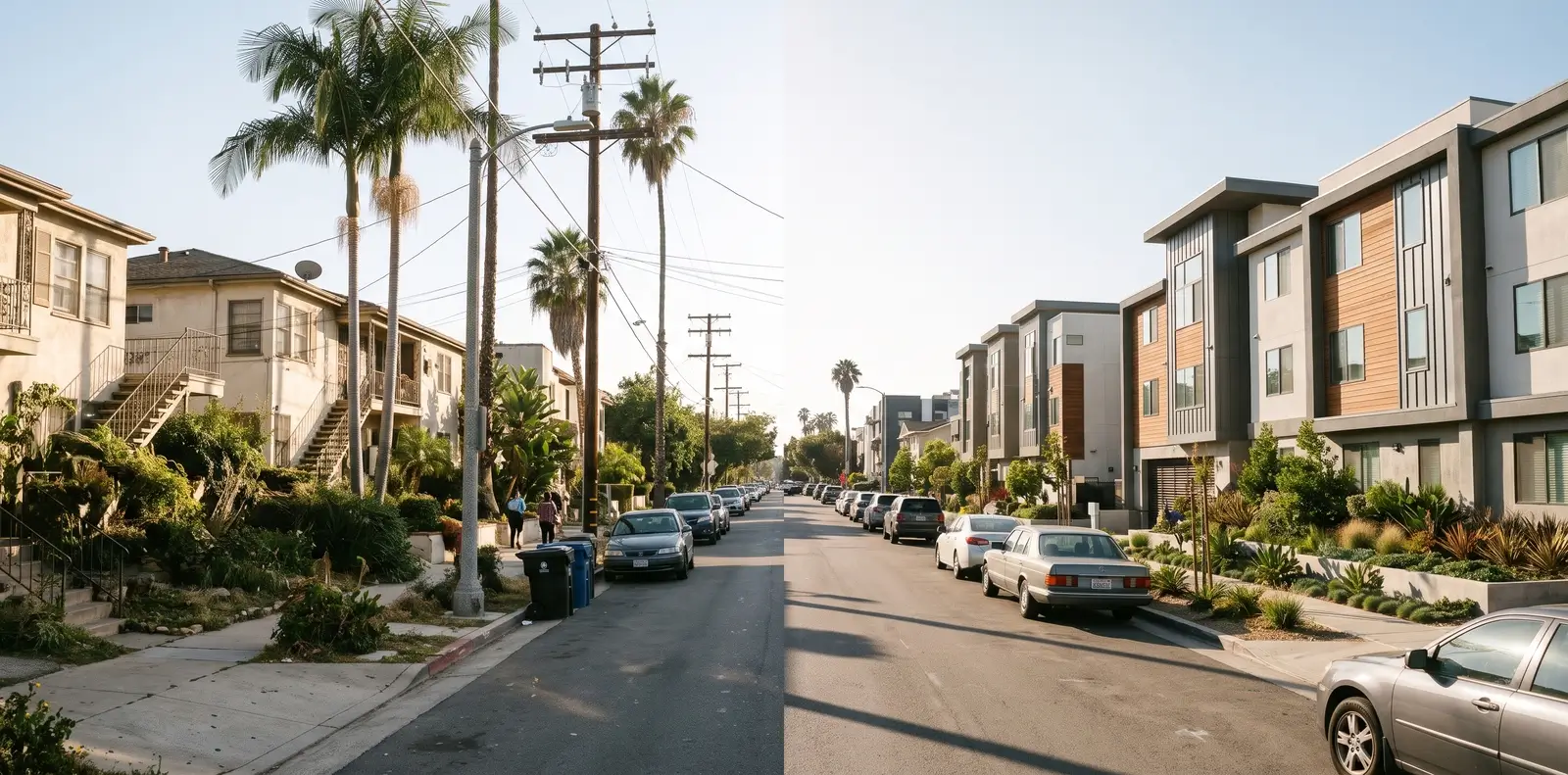
The RSO is the City of Los Angeles' local rent control law. It mainly applies to units in buildings with a certificate of occupancy dated on or before October 1, 1978. That covers a large share of the city's older apartment buildings, duplexes, and multi-unit properties.
Under the RSO, the city sets one allowable annual increase each year. The Los Angeles Housing Department has set that increase at 3% for July 1, 2025, through June 30, 2027. You can raise rent only once in any 12-month period, and you can't save up (or bank) unused increases for later years.
The city also changed the RSO formula in 2026. Future annual increases will be based on 90% of the local Consumer Price Index (CPI), with a floor of 1% and a ceiling of 4%. The old extra 1% add-ons for owners who pay gas or electricity, and the 10% increase for adding a tenant's dependent, were removed for increases taking effect on or after February 2, 2026. If you've been using those add-ons in past years, stop before your next notice goes out.
RSO properties also have to be registered with LAHD each year, and tenants are protected by the city's just cause eviction rules from the start of the tenancy.
What Is AB 1482 (the California Tenant Protection Act)?
AB 1482 is a statewide law that took effect in 2020. It fills the gap for rentals that aren't covered by a stricter local rent control law. Under California Civil Code Section 1947.12, owners can raise rent by 5% plus the regional CPI change, or 10%, whichever is lower, within any 12-month period.
For the Los Angeles area, the LA County Department of Consumer and Business Affairs reports a CPI change of 3.7%, which puts the cap at 8.7% for increases starting August 1, 2026, and running through July 31, 2027.
AB 1482 uses a rolling 15-year rule. If your building received its certificate of occupancy within the last 15 years, it's exempt for now. Once it passes that 15-year mark, it becomes covered.
Common AB 1482 Exemptions
- Buildings that received a certificate of occupancy within the last 15 years
- Single-family homes and condos owned by individuals (not a corporation, REIT, or LLC with a corporate member), as long as the tenant received the required written exemption notice
- Owner-occupied duplexes where the owner lives in one unit
- Deed-restricted affordable housing
- Units already covered by a stricter local rent control law, like the RSO
That written notice is where many owners slip. If your lease doesn't include the specific exemption language required by law, your single-family home may be treated as covered by AB 1482 even if it would otherwise qualify for the exemption.
RSO vs. AB 1482 at a Glance
LA RSO | AB 1482 | |
Where it applies | City of Los Angeles only | Statewide, where no stricter local law applies |
Which buildings | Generally built on or before Oct. 1, 1978 | Generally 15+ years old, with exemptions |
Current cap | 3% (July 1, 2025 to June 30, 2027) | 8.7% in LA area (Aug. 1, 2026 to July 31, 2027) |
Increases per year | One per 12 months | Up to two, but total can't pass the cap |
Registration | Annual registration with LAHD | No registration required |
Just cause rules | Yes, from the start of tenancy | Yes, generally after 12 months |
How to Tell Which Rules Cover Your Property
Before you send any rent increase notice, work through these questions in order:
- Is the property inside the City of Los Angeles? Many addresses say 'Los Angeles' but sit in another city or in unincorporated LA County. Unincorporated areas follow the county's own rent rules, which currently cap most increases at 1.919% through June 30, 2027.
- Is it in a city with its own rent law? Santa Monica, Beverly Hills, Culver City, and Pasadena each have local rules that may apply instead of, or in addition to, state law.
- When was it built? If it's in the City of LA and has a certificate of occupancy dated on or before October 1, 1978, it's likely covered by the RSO. You can check a property's status on ZIMAS under the Housing tab or by calling LAHD.
- Is it at least 15 years old? If it isn't under the RSO but is 15 years or older, AB 1482 most likely applies.
- Does it qualify for an exemption? If it's a single-family home or condo owned by an individual, check that your lease includes the required exemption notice.
Don't Forget About Just Cause Eviction Rules
Rent caps get most of the attention, but both laws also limit when you can end a tenancy. Under AB 1482, most tenants gain just cause protection after 12 months. In the City of Los Angeles, the Just Cause Ordinance extends similar protections to many non-RSO units, and RSO tenants are protected from day one.
In practice, this means you generally need a legal reason, like nonpayment or a lease violation, to end a tenancy. For no-fault reasons, such as moving into the unit yourself, you may owe the tenant relocation assistance. The rules and amounts vary by property type, so check with LAHD or a local attorney before taking action. We covered a related topic in our post on the Right to Counsel Ordinance.
Common Rent Increase Mistakes LA Owners Make
- Assuming a single-family home is exempt. Without the written notice in the lease, the exemption may not hold.
- Using outdated RSO add-ons. The utility and dependent add-ons were removed in 2026.
- Giving too little notice. California requires at least 30 days' written notice for increases of 10% or less, and 90 days for increases over 10%.
- Raising rent twice under the RSO. RSO units allow only one increase every 12 months.
- Skipping RSO registration. Unregistered units can create problems when you try to raise rent or resolve a dispute.
The Benefits and Challenges of Rent-Regulated Properties
Rent rules can feel like a headache, but they don't make Los Angeles a bad place to invest. Older RSO buildings are often in established neighborhoods with steady demand, and rent-stabilized tenants tend to stay longer. Lower turnover means fewer vacancies, less marketing, and fewer make-ready costs between tenants.
The challenge is that your rent growth is limited. If your property's expenses rise faster than the allowable increase, your margins can shrink over time. That's why it pays to keep a close eye on maintenance, insurance, and operating costs, and to plan capital improvements carefully. Owners who understand the rules from the start can price, budget, and plan with fewer surprises.
Frequently Asked Questions
Can I raise rent to market rate when a tenant moves out?
In most cases, yes. Under California's Costa-Hawkins Act, both RSO and AB 1482 units can generally reset to market rent after a tenant leaves voluntarily or is evicted for cause. The new rent then becomes the base for future capped increases.
Does AB 1482 apply to my condo?
It can. A condo owned by an individual may be exempt, but only if the tenant received the required written notice. Condos owned by corporations or REITs are generally covered.
How often does the AB 1482 cap change?
Once a year. The new cap for the Los Angeles area takes effect each August 1, based on the regional CPI.
What happens if I overcharge a tenant?
You may have to refund the extra rent, and you could face penalties or legal action. If you think you've made a mistake, it's best to correct it quickly and get professional advice.
Let Howard Management Group Handle the Rules for You
Rent rules in Los Angeles change often, and one wrong notice can lead to refunds, disputes, or worse. Keeping up with RSO updates, AB 1482 caps, and local city ordinances takes time that most owners would rather spend growing their portfolio.
At Howard Management Group, we track these changes for you. We review each property's coverage, send compliant rent increase notices, handle registration requirements, and keep your leases up to date, so you can collect fair rent without the legal risk. Whether you own a single-family home in Sherman Oaks or an older apartment building in Santa Monica, our team is here to help. Contact Howard Management Group today to learn how we can protect your Los Angeles investment.